GLOBAL MARKETS – POST US ELECTION DAY
US stock markets have recorded their biggest post-election leap in decades.
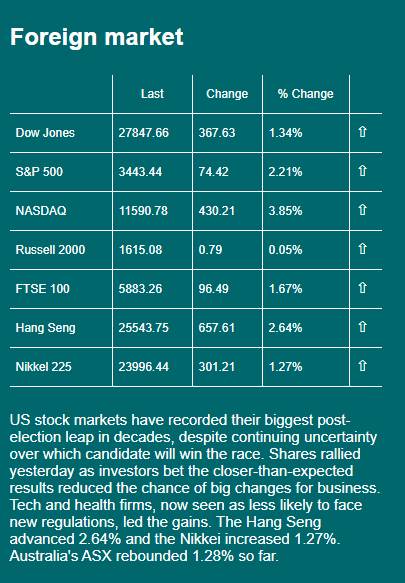

US stock markets have recorded their biggest post-election leap in decades.

A trust itself cannot sue or be sued, because it is not recognised as a legal persona, but rather a legal persona sui generis (which means of its own kind or class), in South Africa (Rosner v Lydia Swanepoel Trust case of 1998). The trustees, in their official capacity, can, however, sue or be sued. All the trustees must join in suing and all must be sued (Mariola v Kaye-Eddie case of 1995). Therefore when a trust is sued or sues, the names of all trustees, rather than the trust itself, are to be sited in pleadings. Even though the names of the trustees will be cited in any action against a trust, it is the trust that will be liable in respect of any claims and not the trustees personally; the trustees merely act in their official capacities as trustees of the trust.
As a general rule, the proper persons to act on behalf of a trust are the trustees, and not the beneficiaries, as they do not have locus standi (a right to appear in a court or before any body, or a right to be heard) (Gross v Pentz case of 1996). Not even a beneficiary’s interest in the trust is sufficient to create locus standi to institute proceedings against parties dealing with a trust, other than against trustees, to protect or recover trust assets (Mariola v Kaye-Eddie case of 1995).
The Gross v Pentz case of 1996, where a trustee has alledgedly disposed of a trust asset below its market value, causing financial loss to the trust, resulting in an action in respect of maladministration of the trust, amounting to a breach of trust and resulting in a monetary loss to the trust, confirmed that there are two types of actions that can be taken:
“Representative actions” – actions brought on behalf of the trust, including:
· to recover trust assets; or
· to nullify transactions entered into by the trust; or
· to recover damages from a third party
The general rule described above applies to these actions. If the trustees properly authorise one of them before action is instituted, then that trustee can act on behalf of the others (Mariola v Kaye-Eddie case of 1995). If one of the trustees, not so authorised, has initiated litigation, his or her actions can be ratified later, subject to the requirement that such trustee had the capacity to act – he or she was authorised by the Master of the High Court in terms of Section 6 of the Trust Property Control Act and the required minimum number of trustees were in office as stipulated in the trust instrument (Pieters Family Trust v PW Colyn case of 2006).
“Direct actions” – actions brought by a beneficiary in his, her or its own right against a trustee for one of the following:
· maladministration of trust assets, resulting in a loss to the beneficiary; or
· failure to pay or transfer to a beneficiary what is due to him, her or it under the trust; or
· paying to or transferring to one beneficiary what is not due to him, her or it
The Court held that only beneficiaries with vested rights can bring a direct action and not a beneficiary with merely a contingent right to income and/or capital (Estate Bazley v Estate Arnott case of 1931). This is because a discretionary/contingent beneficiary will be unable to show that he, she or it personally sustained financial loss, as such beneficiary merely has a ‘spes’ (hope) to receive something from the trust in future. The best such a beneficiary could do is to motivate that the trust sustained a loss as a result of some maladministration, which may result in such beneficiary receiving less in future from the trust, as a result of the diminution of trust assets.
Although the general rule normally applies, in this case the Court however applied the exception to the general rule and allowed the beneficiary to bring the action, as a defaulting trustee cannot be expected to sue himself (this is called the “Beningfield exception” (Benningfield v Baxter case of 1886)) – it therefore modified the general rule, which allowed the beneficiary to bring a representative action as an exception.
It allowed the discretionary beneficiary to bring the case,
as it believed that all beneficiaries have a vested interest in the proper administration of the trust.
The Court therefore confirmed that the beneficiary had the requisite locus to institute the application (this was also confirmed in the July v Mbuqe case of 2017). The Court held that the only alternative to allowing the Benningfield exception would be to require the aggrieved beneficiary to sue for the removal of the trustee and the appointment of a replacement trustee with the hope that the new trustee would bring action against the removed trustee for the recovery of the trust’s assets, or other relief for the recoupment of the loss sustained by the trust. This would impose too cumbersome a process upon the aggrieved beneficiary. The Benningfield exception would however only apply when a beneficiary had no recourse to direct action against the defaulting trustee (Breetzke v Alexander case of 2015).
~ Written by Phia van der Spuy ~

Given the commitment to fiscal consolidation, tax increases of R40bn will be necessary over the next four fiscal years. Taxes are set to increase by R5bn in 2021/2022, R10bn in 2022/23 and R15bn in 2024/2025. The most effective taxes to increase would be personal income tax, which contributes 30% to government revenue and VAT which contributes approximately 25%. Other forms of taxes could also be implemented such as a wealth tax, which would be politically palatable, but can be difficult to implement. A three-year solidarity tax on high-income earners has also been mooted to help pay for the Covid-19 crisis. New tax policies will be announced in the February 2021 Budget.
(Source: AdviceworX)

Minister of Finance Tito Mboweni’s postponed 2020 Medium Term Budget Policy Statement (MTBPS) confirmed expectations that the mini-budget would skirt structural reforms to both bolster economic growth and create jobs.
Below are 10 take-aways from yesterday’s speech:
* Five-year fiscal consolidation pathway to promote economic growth and contain debt and stabilise the ratio of debt-to-GDP at around 95%.
* Gross debt will rise from roughly R4 trillion this year to R5.5 trillion in 2023/24.
* R6.2 trillion spend over the 2021 MTEF which R1.2 trillion will go to learning and culture, R978 billion to social development and R724 billion to health.* Economy forecast to grow by 3.3% in 2021, 1.7% in 2022 and 1.5% in 2023.
* Municipalities to buy electricity from different sources,
* R6.7 billion for the Social Housing Programme aimed at poor, working South Africans.
* A Student Housing Programme (R96 billion) to service nearly 300 000 students a year.
* Regulation 28 to be reviewed and for retirement funds to increase investment in infrastructure,.
* R23bn allocated to Eskom.
* R6.5bn allocated to SAA to settle debt and interest and R10.5 billion to implement its business rescue plan.
(Source: BizNews)

Bwanya v Master of the High Court, Cape Town and Others [2020] ZAWCHC 111
The applicant (B) and R met in February 2014 and they started living together in his house in June 2014. The undisputed evidence before the court was that R treated B as his wife. To friends, with whom they mixed socially, their relationship at all times appeared to be that of a loving couple.
R made several preparations for the two of them to travel to Zimbabwe to meet B’s family, negotiate lobola and prepare for a wedding. R died unexpectedly in April 2016. B lodged claims against the estate as intestate heir as R’s spouse, and under section 2 of the Maintenance of Surviving Spouses Act, 27 of 1990 (MSSA).
The second respondent, the executor of R’s estate, rejected both claims, which rejections were upheld by the Master. This led to B bringing the application that both section 1(1) of the Intestate Succession Act, 81 of 1987 (ISA), and certain provisions of the MSSA are unconstitutional and invalid.
The court (Magona AJ) dealt firstly with section 35(10) of the Administration of Estates Act, 66 of 1965 (AEA) which requires aggrieved parties to lodge an application to review the Master’s decision within thirty days. The court held that this is not a term after which the aggrieved party’s right to bring the application will expire, but merely a time period after which the applicant must seek condonation for the late filing of the application.
The court considered the anomaly that arose in South African law after the decision of the Constitutional Court in Gory v Kolver NO and Others [2006] ZACC 20 in that life partners in a permanent same-sex relationship are regarded as spouses for purposes of section 1 of the ISA, but not life partners in a permanent opposite-sex relationship.
The court held that this constituted unfair discrimination on the basis of gender and sexual orientation and that it is presumed to be unfair under section 9 of the Constitution, 1996. The court found nothing to support a finding that the discrimination is nonetheless fair in the circumstances and ruled that section 1(1) should therefore be read to include the words “or a partner in a permanent opposite-sex life partnership in which the partners had undertaken reciprocal duties of support’ after the word “spouse” wherever it appears. The court also held that as it stands, section 1(1) also impairs the dignity of such an opposite-sex life partner.
Dealing with the MSSA, the court held that it is bound by the precedent set by the Constitutional Court in Volks NO v Robinson and Others [2005] ZACC 2 in which the latter court held that the limitation of a claim under the MSSA to cases where a legal duty of maintenance existed is not unconstitutional.
The court ordered the Minister of Justice (the third respondent) to pay the costs of the application.
The judgement of Magona AJ is now subject to confirmation by the Constitutional Court under section 172(2)(a) of the Constitution.
Comment:
It would be surprising if the Constitutional Court does not confirm this judgement
A properly executed will is always extremely important, and would have avoided the necessity for a court application in the present case.
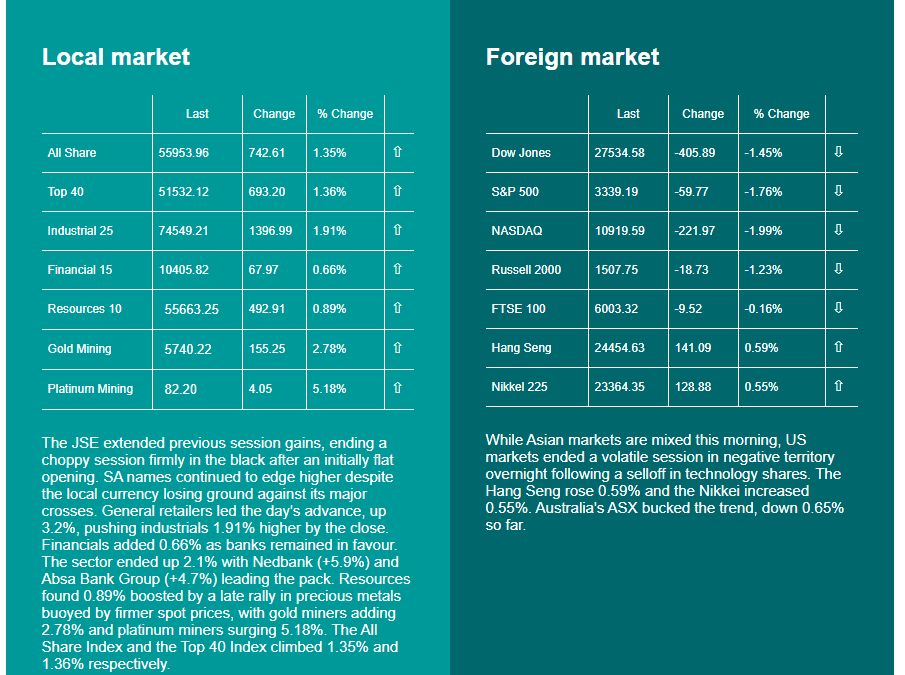
It has been a volatile week on the global markets, due particularly to Tech stock taking quite a knock and vaccine trials having stumbled a bit.
Recent Comments