
May 9, 2022 | Article
Many boards of trustees have made distributions (often on paper only) to beneficiaries for the trusts’ February 2022 financial year-end in order to pay less tax on trust income and capital gains. A number of trustees forget that it does not stop there – beneficiaries had to be informed so they could include the distributions in their respective tax returns, trustees have to manage distributions separately for the beneficiaries and they have to keep proper records.
Do beneficiaries have a right to the distributed amount?
If the trustees decide to utilise the Conduit Principle to make distributions to beneficiaries, the definition of “vest” (as required by the Income Tax Act) to utilise this mechanism, should be understood. It was held in the ITC 76 case of 1927 that a “vested right was something substantial; something which could be measured in money; something which had a present value and could be attached.
” A ‘vested right’ is defined as a “right accrued to a possessor with no conditions”, or the legal definition being “a right belonging completely and unconditionally to a person as a property interest which cannot be impaired or taken away without the consent of the owner.” A vested right cannot be conditional – then it never existed in the first place. A vested personal right to claim payment or transfer of the benefit will form part of the estate of the beneficiary. It cannot just be taken away.
A beneficiary with a vested right has a right to claim an asset and/or income from the trustees, depending on the rights attached to the vested right. Often trust deeds state that trustees do not have to make payment and can retain the amounts in the trust. Beneficiaries do therefore not have an automatic claim against the trustees for payment of such amounts; the terms of the trust deed and the relevant trustee resolution have to be considered.
The manner trustees have to deal in the trust with distributed amounts
The trustees must carefully consider the provisions of the trust instrument when establishing what their specific powers are regarding the making of distributions – are they allowed to retain distributions once they have been made, and are they allowed to invest such retained distributions in the name of the trust, or must they invest it in the name of the relevant beneficiary?
Even though the ownership of such distribution lies with the beneficiary, often trustees retain it in the trust and invest it in the name of the trust rather than in the name of the beneficiary. This equates to a loan to the trust from the beneficiary to the extent of the amount that vested in that beneficiary.
In these circumstances, a loan agreement should be drawn up which stipulates the repayment terms, as well as whether it is interest-bearing or interest-free. If the loan is interest-free or attracts interest at a rate below the variable official rate of interest, Donations Tax will be payable on the interest ‘donated’ in terms of Section 7C of the Income Tax Act, which taxes loans to trusts by ‘connected persons’ in relation to those trusts – beneficiaries of those trusts or ‘connected persons’ in relation to such beneficiaries – with interest rates charged at below the variable official rate of interest.
If the investment or money is being held on behalf of the beneficiary, then no loan account exists since the beneficiary has a vested right – a right to claim an asset and/or income and/or capital gains from the trustees, through the trustees having exercised their discretion, but subject to the rights attached to such vested right – in the investment or money, and any income or benefits arising from such investment will accrue directly to the beneficiary.
Since Section 1 of the Income Tax Act defines “gross income” as “the total amount in cash or otherwise, received by or accrued to or in favour of that resident”, any income earned on the vested amount will be deemed income in the hands of the beneficiary and will accrue to the beneficiary. The amount vested in the beneficiary will continue to grow within the trust, although the trust will not be taxed on such amounts but rather the beneficiary. If no income is declared, it will, in all probability, be necessary to prove that the asset did not yield income. Since no loan exists in this scenario, Section 7C will not apply.
SARS issued a Binding Private Ruling (“BPR”) (BPR 350) on 26 August 2020 dealing with the tax treatment of the vesting of a capital gain in a beneficiary of a trust where payment of the capital gain is deferred at the discretion of the trustees and the capital gain is invested on behalf of the beneficiary. SARS ruled that Section 7C would not apply to the proposed transaction but specifically confirmed that any subsequent income earned on the vested amount (or income apportioned to the vested amount against which enjoyment has been withheld) would accrue to the beneficiary and should be included in the gross income of the beneficiary.
Conclusion
It is therefore essential that trustees carefully word resolutions when amounts are awarded to beneficiaries, especially when these amounts are not actually paid over to beneficiaries at the time. It should stipulate all the terms of the decision in alignment with the trust instrument. The trustees will need a proper system to keep a careful record of amounts vested, how these amounts were invested, and the income earned in respect thereof. Trustees’ subsequent actions should also be in alignment with the resolution to avoid any unintended tax consequences.
~ Written by Phia van der Spuy ~

Apr 26, 2022 | Article
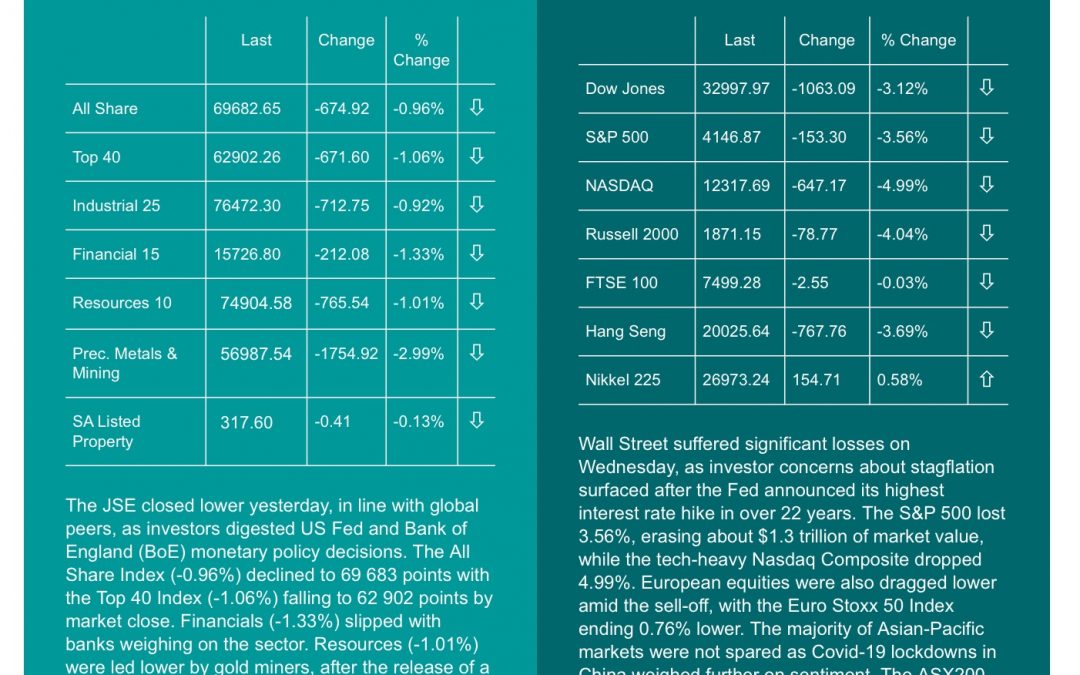
Stock markets and oil prices slumped yesterday on growing concern that lockdowns in China aimed at fighting a worsening Covid outbreak could further harm a world economy battling decades-high inflation. The JSE’s All-Share Index dropped 3.5% yesterday, with Anglo (-7.5%), Sibanye (-6.5%) and Sasol (-6%) among the biggest losers. The losses extended last week’s sell-off triggered by Federal Reserve boss Jerome Powell indicating that the US central bank would hike interest rates by half a percentage point next month and possibly several times more this year. That has lent strong support to the Dollar, which is benefitting also from its traditional haven status. The Rand slumped more than 2% yesterday, and was trading at R15.70/$ – its worst level since January this year. Dollar-denominated oil prices tumbled more than 5% yesterday. (AFP/Fin24)

Mar 25, 2022 | Article
Recent case again emphasises the importance of a will.
By Amanda Visser 15 Mar 2022 00:04
Image: Shutterstock
Life partners, whether in a same-sex or opposite sex relationship, will in future be treated as a “spouse”, allowing them to inherit or claim maintenance from their deceased partner’s estate under the Intestate Succession and the Maintenance of Surviving Spouses Acts.
This follows a recent judgment in the Constitutional Court ruling that both acts were unconstitutional and had to be amended by Parliament within 18 months of the ruling.
Louis van Vuren, CEO of the Fiduciary Institute of Southern Africa (Fisa), says the case was initially decided in the Western Cape High Court when Jane Bwanya sought an order to have certain provisions of the two acts declared unconstitutional.
Bwanya was in a relationship with Anthony Ruch and they were planning to get married. However, Ruch died unexpectedly and without a valid will in place.
In broad terms, in terms of the Intestate Succession Act (ISA) the benefits in the estate go to the spouse or children, or the parents of the deceased when there is no spouse or children.
In the 2006 case, Gory v Kolver, Mr Gory was the survivor in a same-sex relationship and successfully applied to the Constitutional Court to be regarded as a “spouse”. At the time partners in a same-sex relationship could not formalise their relationship in any way; it was only after the promulgation of the Civil Union Act that this became possible.
The court found that Section 1 of the Intestate Succession Act was unconstitutional as it discriminated based on marital status, and Gory was able to inherit from his partner’s estate.
“This led to an anomaly in our law where the law allowed partners in a same-sex relationship to inherit from each other in the absence of a will, but partners in an opposite sex relationship could not,” says Van Vuren.
In an earlier decision in 2005 the Constitutional Court found in the Volks v Robinson matter that a claim under the Maintenance of Surviving Spouses Act (MSSA) was not available to a partner in an opposite sex relationship who did not tie the knot. The surviving partner could not be considered a “spouse” under the MSSA, as this legislation defined a “spouse” as a spouse in a marriage.
The gist of the judgment was that people in a cohabitation relationship made a choice not to get married, even if they could, and therefore had to live with the consequences.
In the Bwanya matter the Western Cape High Court ordered in her favour that the ISA was unconstitutional because it discriminated unfairly on the basis of marital status, but rejected her claim under the MSSA because the court had to follow the Volks judgment handed down by a higher court.
The Bwanya matter went to the Constitutional Court to have the order of unconstitutionality of the ISA certified. Bwanya was also granted leave to appeal to the court to consider the decision that she does not have a claim under the MSSA.
“That is when the fun started,” says Van Vuren.
Six judges held that the court was not bound by the Volks v Robinson decision since the facts of the matter before them differed from the earlier case. The court said there were more than three million South Africans in life partnerships and by not extending the right to inherit from each other under intestate law amounts to unfair discrimination on marital status.
The court said the argument that parties who do not get married choose not to do so does not take cognisance of the vulnerable position of especially women in relationships.
It ordered that both the ISA and MSSA were unconstitutional and should be read to include “a partner in a life partnership complying with the reciprocal duties of care, maintenance and support”.
In two dissenting judgments four judges, including former chief justice Mogoeng Mogoeng, argued that the majority did not advance sound reasons why the decision in Volks was “demonstrably wrong”. They felt the court remained bound by the prior judgment.
Van Vuren says it is important for an executor in a deceased estate to take note of the majority judgment in the Bwanya matter should they encounter similar circumstances.
“The only logical thing to do is to either wait until Parliament has amended the acts or accept that the claim against the estate is valid. If you do not, then the survivor in such a relationship will simply take the matter to court again.”
It is unclear why the effect of the order was postponed for 18 months, remarks Van Vuren. It should not be difficult to amend the acts, since there is already a very broad definition of spouse in both the Income Tax Act and the Estate Duty Act.
He warns against the perception that it is not necessary to have a proper will on the back of the Bwanya case. There are several practical reasons why it remains necessary. One is that the ISA provides for the spouse and descendants to benefit from the estate. If the estate is worth R1.6 million but most of it is tied up in a property it may have to be sold to be divided equally between the spouse and children, especially if the spouse is not the natural parent of the children.
Another reason is that all estates above R250 000 require the appointment of an executor. In the absence of a will this could cause unnecessary delays.
“Our advice is to find someone who knows what they are doing to draft your will,” says Van Vuren. “The cost could be extreme if you do not.”
Brought to you by the Fiduciary Institute of Southern Africa (Fisa).

Recent Comments