Market Movements
Source: FNB Securities
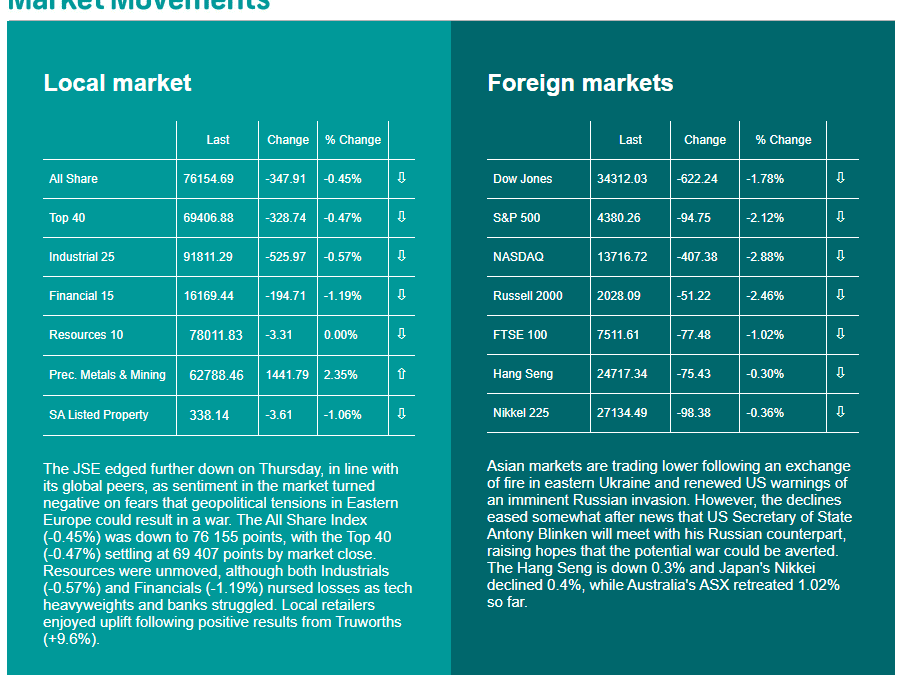
The JSE edged further down on Thursday, inline with its global peers, as sentiment in the market turned on fears that geopolitical tensions in Eastern Europe could result in war.

Source: FNB Securities
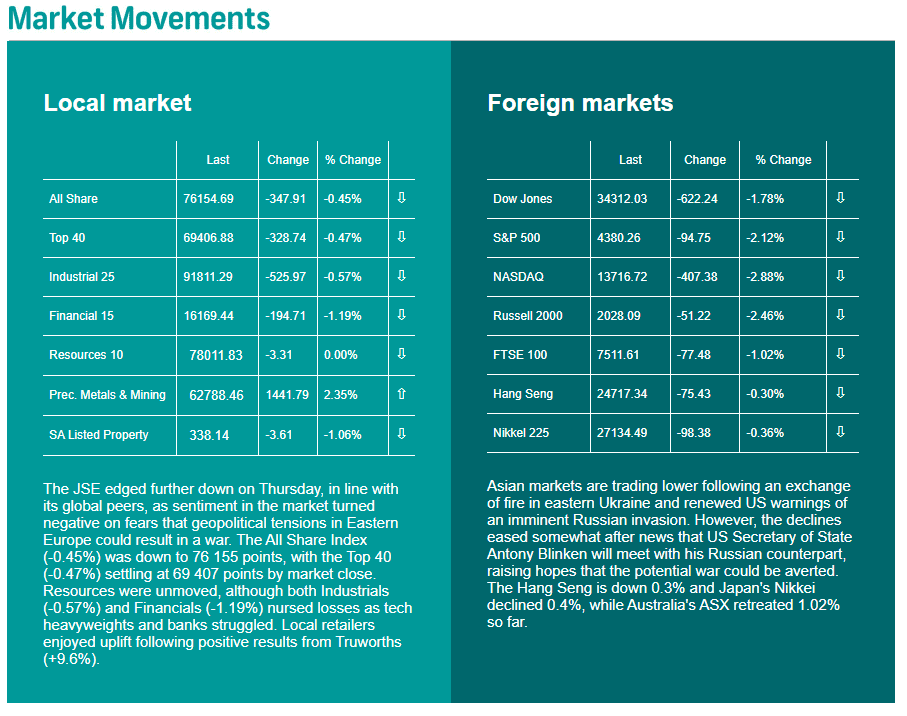
The JSE edged further down on Thursday, inline with its global peers, as sentiment in the market turned on fears that geopolitical tensions in Eastern Europe could result in war.

Often trustees rely on the majority decision in trust instruments to make decisions. This is often done to deliberately exclude one or more trustees from decision making. The Courts have, however, in many cases, confirmed the ‘Joint Action Rule’, whereby trustees are required to act jointly in dealing with trust assets.
It is a fundamental rule of trust law that, in the absence of contrary provisions in the trust instrument, the trustees must act jointly if the trust’s estate is to be bound by their acts, and a unanimous vote will be required in matters of substance. The rule derives itself from the nature of the trustees’ joint ownership of the trust assets in ownership trusts. Since co-owners must act jointly, trustees must also act jointly (Coetzee v Peet Smith Trust case of 2003 and Nieuwoudt v Vrystaat Mielies case of 2004).
Co-trustees are required to act jointly concerning trust administration at all times. When dealing with third parties, even if the trust instrument stipulates that a decision can be made by the majority of trustees, all trustees are required to be involved in the decision and have to sign each resolution (Land and Agricultural Bank of South Africa v Parker case of 2005).
The following was held in the Parker case – “It is a fundamental rule of trust law, which this Court recently restated in Nieuwoudt and Another NNO v Vrystaat Mielies (Edms) Bpk, that in the absence of contrary provision in the trust deed the trustees must act jointly if the trust estate is to be bound by their acts.
The rule derives from the nature of the trustees’ joint ownership of the trust property. Since co-owners must act jointly, trustees must also act jointly. Professor Tony Honoré’s authoritative historical exposition has shown that the joint action requirement was already being enforced as early as 1848. It has thus formed the basis of trust law in this country for well over a century and half.”
It is not the majority vote but the resolution (signed by all trustees) that binds a trust. A trust operates on resolutions and not on votes. Bearing in mind that a trust operates using resolutions (Steyn v Blockpave case of 2011), all trustees must be notified of a decision to be considered by the trustees. The Court emphasised that a trust functions through its appointed trustees and that its lack of legal personality requires that all trustees act together for and on behalf of the trust.
As long as the trust instrument allows for it, decisions of trustees can be made by majority decision, as long as the necessary quorum (all trustees) was present at the meeting and all trustees were invited to and given an opportunity to participate in the meeting.
The judge held in the van der Merwe NO and Others v Hydraberg Hydraulics CC and Others, van der Merwe NO and Others v Bosman and Others case of 2010 that the terms of the trust instrument that provide for the trustees to make decisions by a majority vote at a quorate meeting do not provide an exception to the rule that all the trustees must act jointly – they merely provide that a majority decision will bind the minority or absent trustees. The minority is, however, obliged to act jointly with the other trustees in executing the resolution adopted by the majority.
Even if a trust instrument allows for the majority of trustees to form a quorum for a trustees’ meeting – or allows for the majority decision of trustees – such majority may perfectly take a valid internal decision by acting together on the internal front. It will not, however, be a valid resolution that externally binds a trust unless it is signed by all trustees, including absent trustees in whose absence it was taken, as well as disagreeing trustees.
In the le Grange v the Louis and Andre le Grange Family Trust case of 2017, the judge excellently summarised the obligation of acting jointly, as follows: “Acting jointly means that the trustees must participate in the decisions taken on behalf of the trust. Participation usually involves meetings or consultations amongst trustees, negotiating or mediating contested decisions and ultimately in the absence of consensus or resolution contested issues are determined by a vote.
Trustees may participate in a vote in three ways: vote for or against a motion or abstain from voting altogether. All three forms of participation in the decision-making are self-conscious and deliberative actions. Participation is elicited after proper notice to the trustees.
A trustee who has no knowledge of decisions taken or to be taken on behalf of a trust and consequently does not vote in any decision, cannot be said to have participated in decision-making on behalf of that trust. Consequently, even if the majority of trustees arrive at a decision but without the participation of all the trustees, unless the trust deed authorises otherwise, the ensuing decision albeit a decision of the majority is not a decision on behalf of the trust.”
Trustees have to present a united front, irrespective of internal disagreement, in the form of a duly signed resolution by all the trustees. The judge also confirmed that the minority trustees must subject themselves to the democratic vote of the majority and co-sign the resolution taken by the majority trustees.
Trustees should therefore be mindful to deliberately exclude certain trustees from trust decisions, as those decisions may be rendered invalid.
~ Written by Phia van der Spuy ~

Deputy Justice Minister John Jeffery has seen for himself the poor service the public and law practitioners have to put up with after making a surprise visit to the Master’s Office in Pretoria on Friday, reports Legalbrief. The inspection follows a previously unannounced visit to the Cape Town Master’s Office.
A report in The Citizen notes several legal and insolvency practitioners have expressed concerns about shocking service delivery and massive backlogs at Master’s Offices around the country. The department said service delivery was initially negatively affected by Covid-19 and then further exacerbated by a ransomware cyber-attack last year. Jeffery – who was joined by deputy chairperson of the Legal Practice Council, Advocate Kennedy Tsatsawane – found that while several improvements had supposedly been made, the public were still faced with poor service delivery. ‘Although the queues were shorter than in Cape Town, queue management and the directing of members of the public to the correct sections could be improved,’ read a statement from the Justice Department.
There were also complaints of staff shortages, equipment taking too long to be repaired and an insufficient number of printers. As with the Cape Town Master’s Office, there were complaints of e-mails and phones going unanswered. IT issues remain a challenge, says the report. According to the statement, Jeffery ‘is in ongoing discussions with both the Chief Master and the DG of the Justice Department to find solutions’. Meanwhile, the Deputy Minister plans to continue making unannounced visits throughout the country.
Source: LegalBrief

News of this week’s landmark CCMA ruling that the dismissal of an employee for refusing to be vaccinated against Covid-19 was fair has upped the stakes on workplace vaccination policies. The commission ruled that she could be dismissed because she had ‘refused to participate in the creation of a safe working environment’.
As legal writer Tania Broughton reports on the GroundUp site, the ruling, by Gauteng commissioner Lungile Matshaka, is the first to come to light on the issue of workplace mandatory vaccine policies. Goldrush Group business and training officer Theresa Mulderij, was appealing against her dismissal for ‘incapacity’. She wanted to be either reinstated or fully compensated.
At the hearing, company representatives explained the steps leading up to the adoption of its mandatory workplace vaccination policy. They said consultations had been held with unions and employees over a three-month period. Staff had been given an overview of the benefits of vaccination. Specialists, including a doctor, traditional healer, virologist and a human rights commissioner had been made available to answer questions. The policy included a provision for exemption. Mulderij applied for an exemption but was turned down. According to Matshaka’s ruling, she had first attempted to get a medical exemption, but no doctor had been willing to assist her. She then relied on her constitutional right to bodily integrity. This application was turned down by the exemption committee. ‘The committee identified her as a high-risk individual who interacts with colleagues daily whilst on duty in confined, uncontrollable spaces. This, according to the committee, put her at risk and exposes other colleagues to risk,’ the commissionersaid.
Matshaka said he had listened carefully to what Mulderij had said at the CCMA hearing: that she had a constitutional right to bodily integrity; that she felt extreme social pressure and emotional discomfort about deciding between her livelihood and accepting the vaccine under current conditions; and that she did not trust the vaccine and had a personal fear as to what it might do to her.
She had said since the beginning of lockdown, she had strictly followed Covid protocols, both general protocols and those introduced by the company. To her knowledge, she had not yet been infected or infected anyone else, notes the GroundUp report. ‘She is aware that it has been confirmed by the World Health Organisation that the vaccine does not stop the spread or contraction of the virus, but only serves to minimise the severity of symptoms. She does not believe that this vaccine is for the greater good or wellbeing of people but only for the good of the individual themselves,’ the commissioner said. He The Commissioner that said the mandatory workplace vaccination policy, from its drafting up to its implementation, had followed all the crucial steps. He could only conclude that Mulderij was ‘permanently incapacitated’ on the basis of her decision not to get vaccinated and her refusal to participate in the creation of a safe working environment.
Source: LegaBrief

The government has claimed that backlogs at the country’s 15 Master’s Offices have been ‘reduced significantly’, with progress having been made in stabilising the IT systems to deal with the caseload, which increased dramatically during the various stages of lockdown last year. The Department of Justice & Constitutional Development admitted to Business Day that the backlog had affected its ability to deliver services. It said these had ‘impacted negatively on the image of the Master’s Office’.
However, department spokesperson Steve Mahlangu said the Master’s Office branch in the department had been focused on ‘attending to the backlog in all the 15 offices. ‘The report from most of those offices is that a substantial number of matters have been attended to. Backlogs have been reduced significantly and all staff are continuously working hard towards returning to normal caseloads,’ said Mahlangu. ‘Significant progress has been achieved despite the challenges of load-shedding affecting offices that were doing overtime work, which made it difficult to manage the situation. Currently, our IT system has not fully stabilised, but there is progress being made.’
Source: LegalBrief
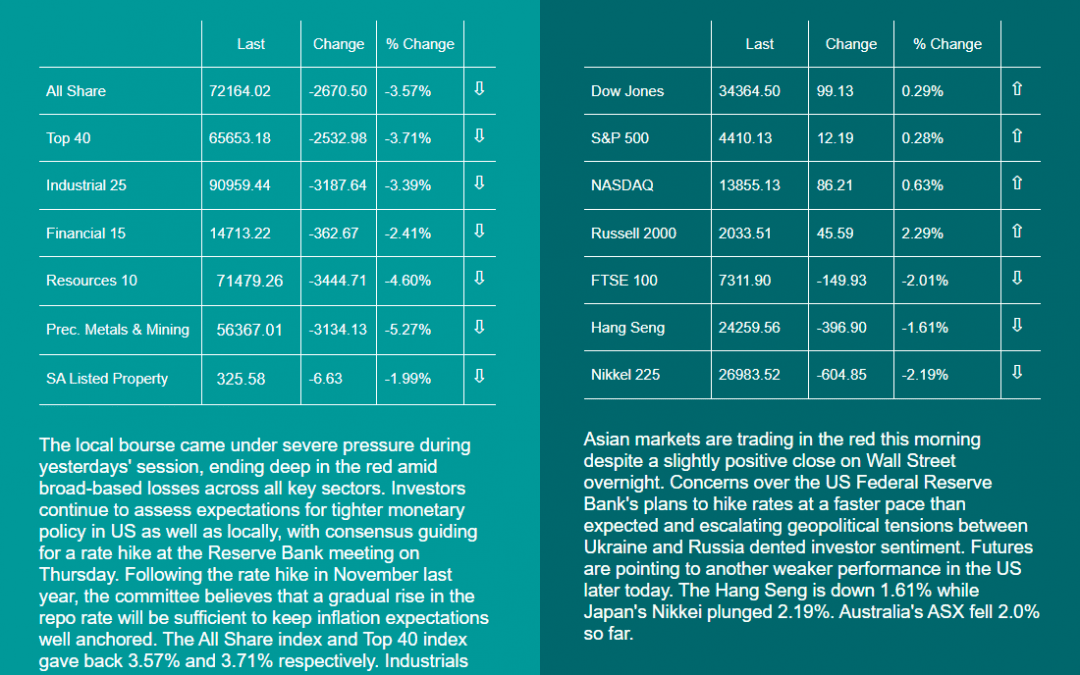

The markets have experienced some big bumps over the last few days due to concerns over tightening US Federal Reserve Bank’s monetary policy, and the geo-political concerns in Europe.
Source: FNB Securities
Recent Comments